The SLM converts prepared loan documents and borrower evidence into structured, explainable and review-aware signals that can support governed covenant-monitoring workflows. It does not replace credit officers, legal teams, risk users, enterprise systems of record or final lender judgment.
Domain-Tuned Lending Intelligence, Built for Controlled Use
CovenantOps Lending SLM is Ligaments.ai's fine-tuned lending model capability for covenant and post-disbursement monitoring workflows. It is designed for lenders, private credit teams, specialty finance firms, credit unions, loan servicers, mortgage and housing lenders, and regulated lending operations that need more than generic document Q&A.
The model does not replace covenant monitoring platforms, loan systems, credit officers, legal teams or risk users. It acts as the domain intelligence layer that interprets covenant clauses and borrower evidence so governed systems can create structured, source-backed monitoring actions.
Why Generic AI Falls Short in Covenant Monitoring
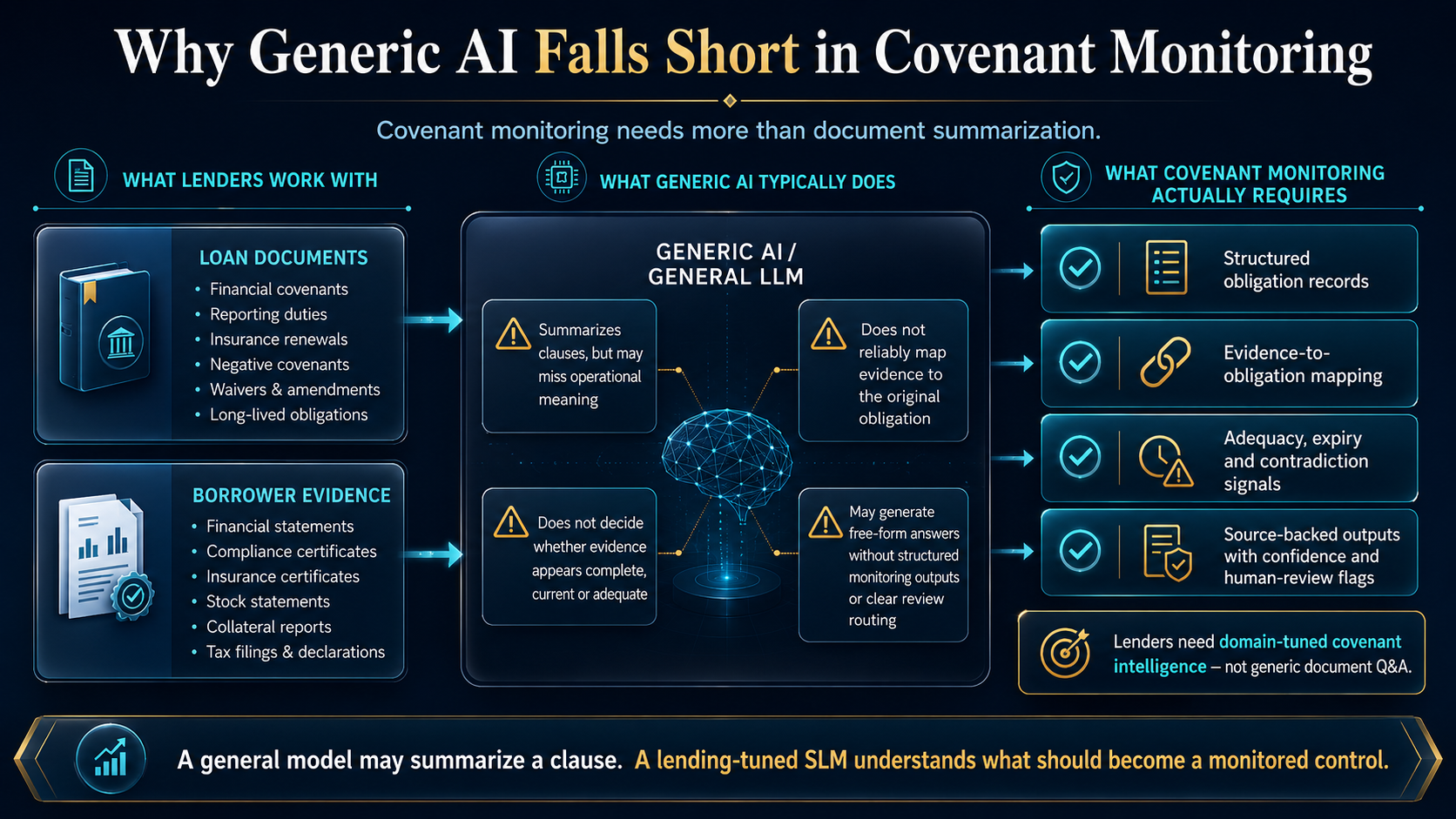
Loan documents are not simply long documents. They contain operating commitments that continue for years after disbursement: reporting duties, financial covenants, insurance renewals, borrower undertakings, security obligations, negative covenants, conditions precedent, conditions subsequent, waivers and amendment-driven changes.
Borrower evidence is equally important. Financial statements, insurance certificates, compliance certificates, stock statements, collateral reports, tax filings and borrower declarations must be assessed against the original covenant requirement, not merely stored as uploaded files.
A general model may summarize a clause. A lending-tuned SLM is built to understand what should become a monitored control, what evidence is required, whether submitted evidence appears complete and current, and what should be routed to human review.
 Why Generic AI Falls Short in Covenant Monitoring
What CovenantOps Lending SLM Understands
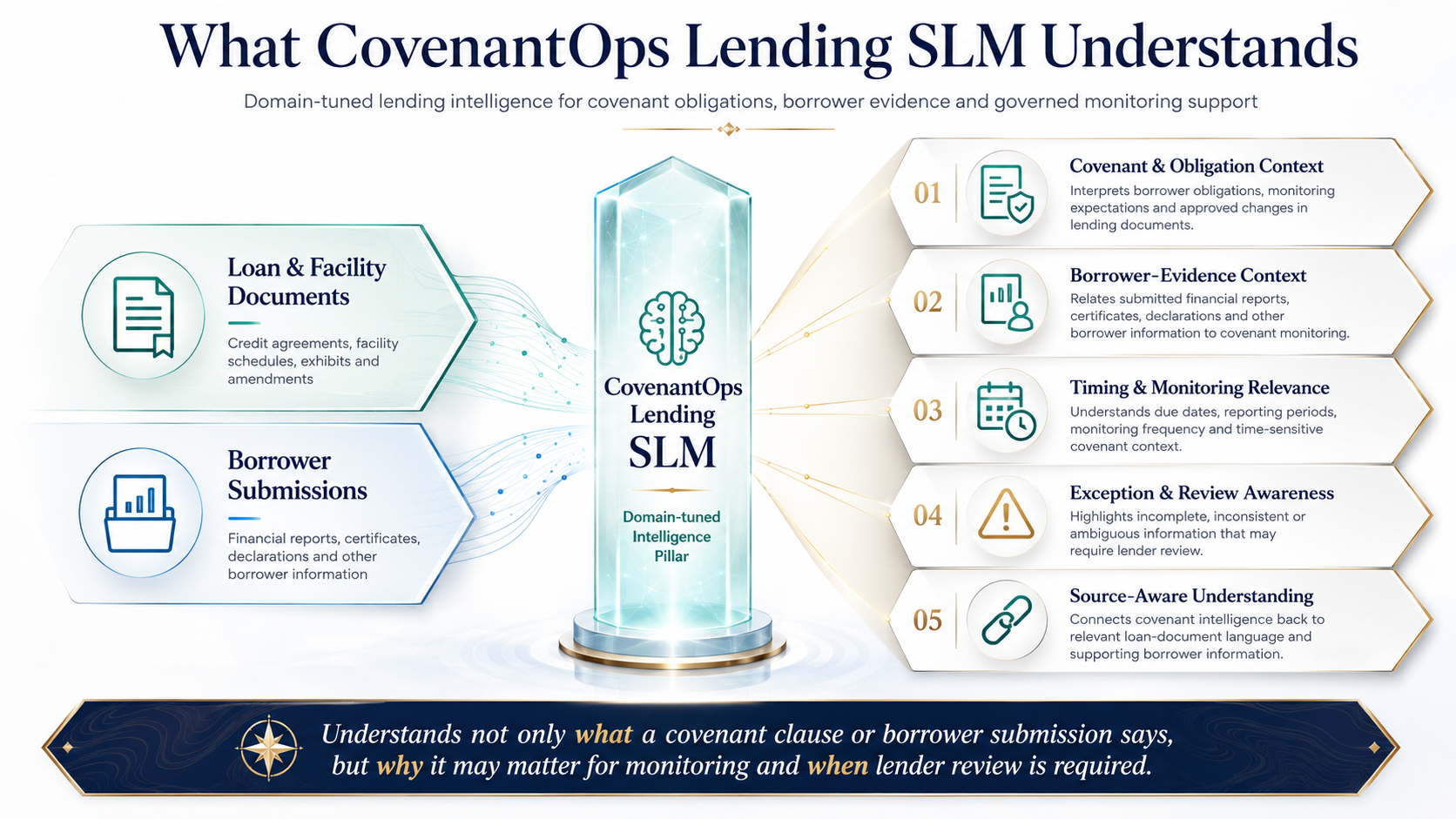
CovenantOps Lending SLM is tuned to understand both sides of covenant monitoring: the borrower obligations contained in approved lending documents and the supporting information submitted during the life of the facility.
Rather than treating loan documents and borrower evidence as unrelated files, the model helps interpret how obligations, evidence expectations, timelines and review considerations connect within post-disbursement monitoring.
 What CovenantOps Lending SLM Understands
CovenantOps Lending SLM brings together covenant context, borrower-evidence understanding, timing awareness, exception recognition and source-backed interpretation to support more structured and review-ready monitoring intelligence.
It supports covenant monitoring but does not independently determine covenant status, approve waivers or replace authorised lender judgment.
CovenantOps Lending SLM understands not only what a covenant clause or borrower submission says, but why it may matter for monitoring and when lender review is required.
Financial Covenant Intelligence for Governed Review
Financial covenants require more than clause interpretation. They involve understanding the relevant financial measure, applicable threshold, testing period, supporting borrower information and lender-approved assessment approach.
CovenantOps Lending SLM helps interpret the financial-covenant requirement and identify the related metric, period context, evidence expectations and supporting information available in approved borrower submissions.
The model provides structured, source-aware context that can support established lender calculations and professional review. Approved organisational methods, authoritative financial information and authorised lender personnel determine the final covenant calculation, status and appropriate action.
The SLM explains the financial-covenant context. Approved lender controls and professional judgment determine the final position.
From Covenant Intelligence to Review-Ready Lending Workflows
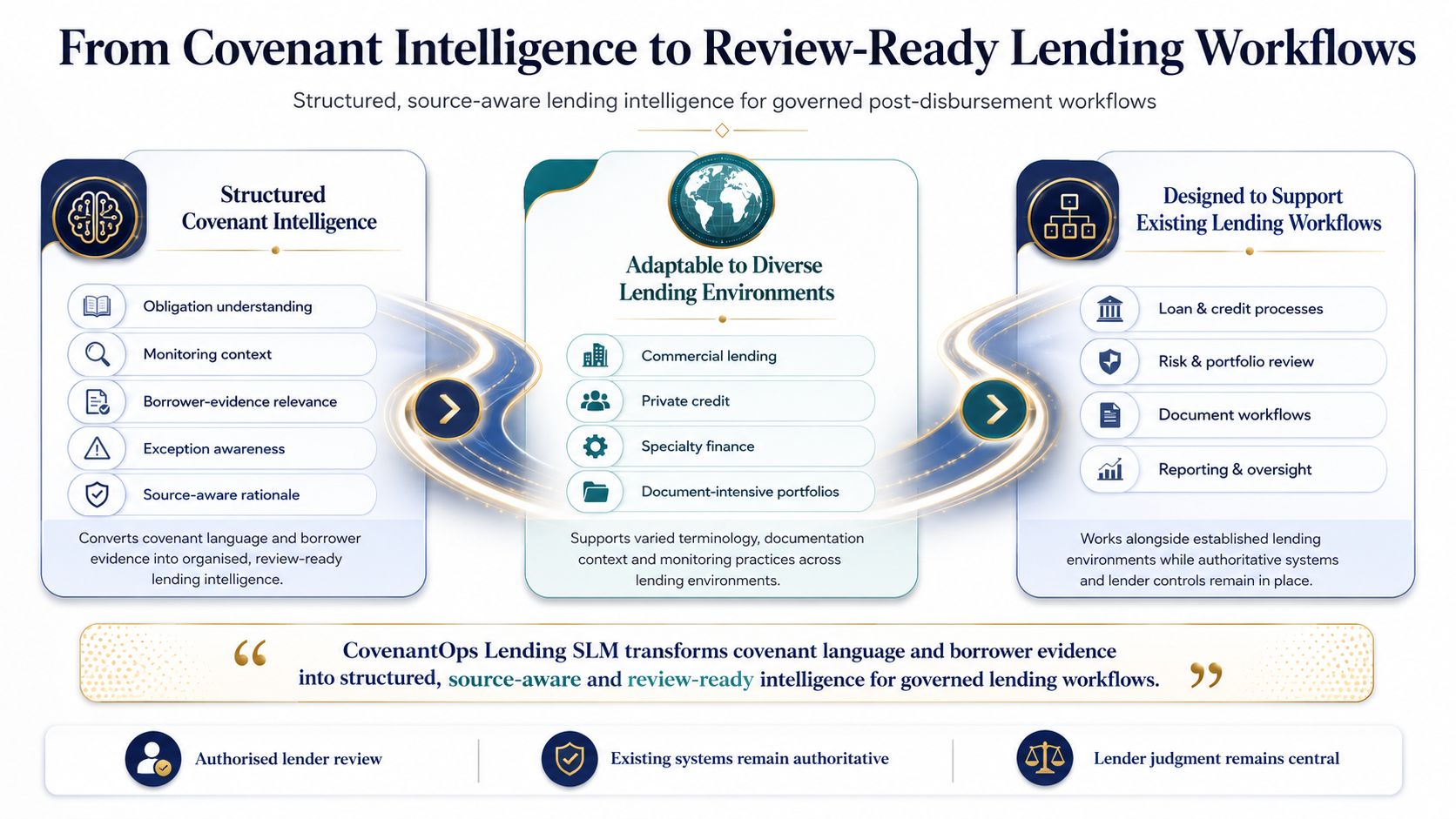
CovenantOps Lending SLM converts prepared covenant information and borrower evidence into structured, source-aware and review-ready lending intelligence.
Rather than producing free-form document summaries alone, it helps lender teams obtain clearer obligation context, evidence understanding, monitoring relevance and exception awareness for governed post-disbursement workflows.
 From Covenant Intelligence to Review-Ready Lending Workflows
Structured covenant intelligence
The SLM can provide organised information that supports:
- Covenant and obligation understanding
- Monitoring and timing context
- Borrower-evidence relevance
- Exception and clarification awareness
- Source-aware supporting rationale
- Review-ready lending summaries
The model provides domain-focused intelligence, while authorised lender personnel and approved organisational controls determine how that intelligence is validated and used.
Adaptable to diverse lending environments
Covenant terminology, documentation practices, products and evidence expectations can differ across lenders, portfolios and markets.
CovenantOps Lending SLM is designed to support varied commercial-lending, private-credit, specialty-finance and other document-intensive lending environments.
Its use can be aligned with the lender’s established terminology, documentation context and monitoring practices without positioning the model as a replacement for lender-specific policy or professional judgment.
Designed to support existing lending workflows
CovenantOps Lending SLM can operate as the domain-intelligence layer within CovenantOps and other approved lending environments.
It is designed to work alongside existing loan, document, credit, risk, reporting and portfolio-monitoring processes rather than replacing authoritative enterprise systems.
Authorised lender teams retain responsibility for covenant approval, legal interpretation, calculation methods, waiver decisions, monitoring actions, credit judgment and risk escalation.
CovenantOps Lending SLM transforms covenant language and borrower evidence into structured, source-aware and review-ready intelligence for governed lending workflows.
Measurable Value: Model Quality and Business Impact
The SLM should be measured in two ways: the quality of intelligence it produces, and the operational value that intelligence can unlock when embedded into CovenantOps or a lender’s existing workflow.
SLM Quality Indicators
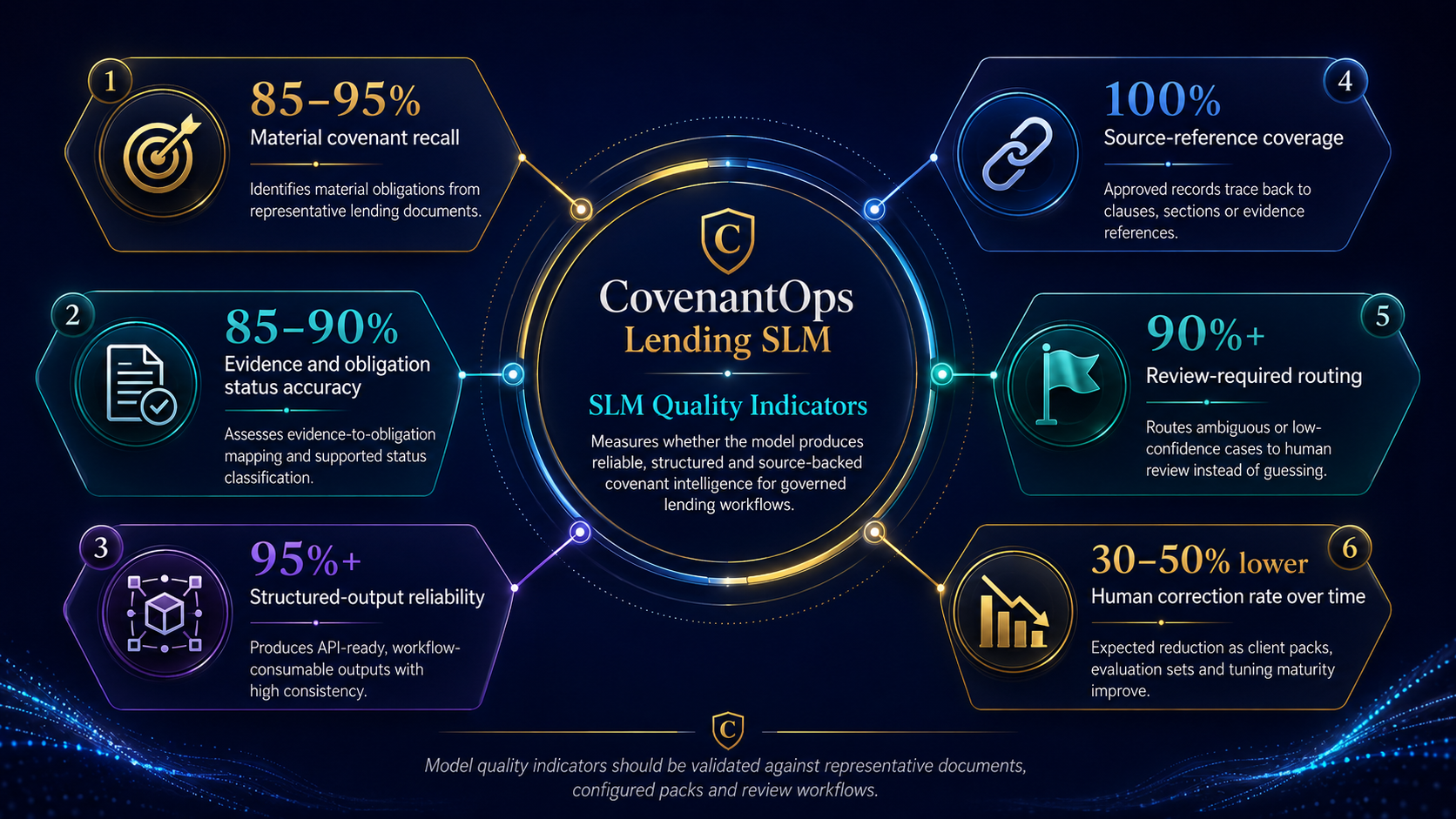
CovenantOps Lending SLM should be evaluated not only by whether it can interpret covenant text, but by whether it can produce reliable, structured and source-backed intelligence that can safely support governed lending workflows. These quality indicators measure how well the model identifies material covenants, maps borrower evidence to obligations, produces API-ready outputs, preserves source references and routes ambiguous cases to human review instead of forcing an answer.
Together, these indicators help lenders assess whether the SLM is ready to operate as a trusted covenant-intelligence layer inside CovenantOps or an existing lending ecosystem.
 SLM Quality Indicators
85–95% Material covenant recall
Model benchmark range for identifying material obligations from representative loan packages after workflow stabilization, subject to document quality, product type and configured market pack.
85–90% Evidence-status accuracy
Model benchmark range for evidence-to-obligation mapping and status classification for configured evidence types such as financial statements, insurance certificates, stock statements and compliance certificates.
95%+ Structured-output reliability
Benchmark level for JSON/API-ready outputs that can be consumed by rules engines, dashboards and workflow systems without manual reformatting.
100% Source reference for approved records
Operating requirement for downstream records that are accepted into monitoring: every approved obligation or evidence finding should point back to the supporting clause, section or evidence reference.
90%+ Review-required routing for ambiguous cases
Benchmark quality for routing unclear, conflicting, unsupported or low-confidence items to human review instead of guessing.
30–50% Lower human correction rate over time
Expected reduction in material reviewer corrections as client packs, evaluation sets and fine-tuning data mature across successive releases.
Operational Outcomes Enabled by the SLM
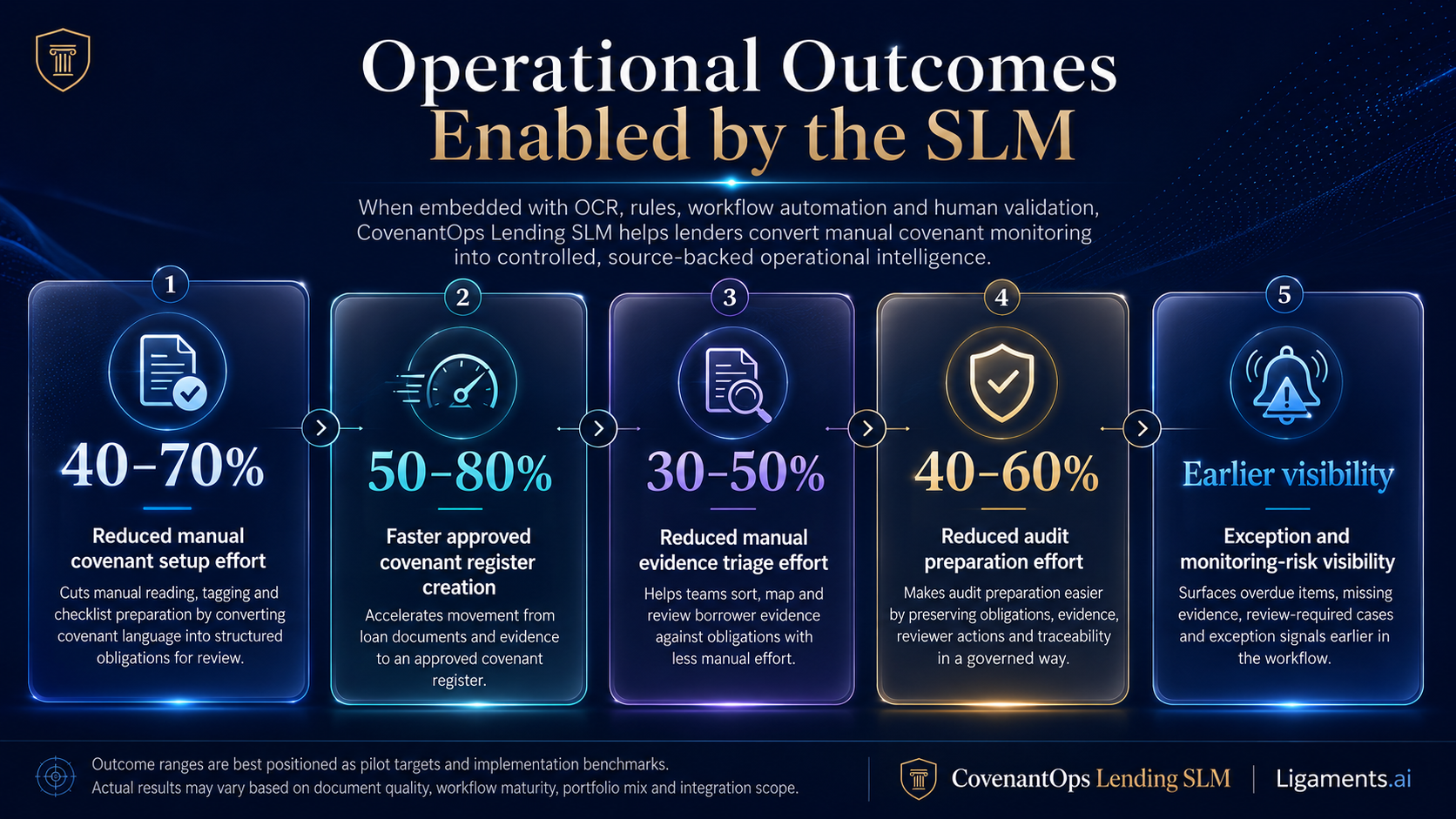
When embedded with OCR, rules, workflow and human validation, CovenantOps Lending SLM is designed to help lenders move from manual covenant interpretation to controlled covenant intelligence.
 Operational Outcomes Enabled by the SLM
40–70% reduction in manual covenant setup effort
By converting covenant clauses into structured, review-ready obligation records.
50–80% faster creation of approved covenant registers
For new facilities when paired with validation workflow and reviewer confirmation.
30–50% reduction in manual evidence triage effort
By mapping submitted borrower evidence to the corresponding covenant requirement and flagging adequacy issues.
40–60% reduction in audit preparation effort
For covenant-monitoring reviews by preserving source references, rationale and reviewer actions.
Earlier exception visibility
By surfacing missing, expired, inadequate, contradictory and review-required evidence before periodic reviews are delayed.
Governed and Review-Aware by Design
In lending, trust matters more than novelty. CovenantOps Lending SLM is designed for controlled use in environments where source evidence, professional oversight and accountable decision-making are essential.
It provides structured covenant and borrower-evidence intelligence to support monitoring and review. It does not independently determine covenant status, approve obligations, calculate the final financial-covenant position or initiate lender action.
Source-aware intelligence
The model helps associate its interpretation with relevant covenant language and approved borrower information so users can understand the basis of the output.
Professional review remains central
Credit, risk, operations, legal and other authorised lender personnel retain responsibility for covenant interpretation, approval, waiver decisions, monitoring actions and escalation.
Review when information is uncertain
Incomplete, inconsistent, unsupported or ambiguous information can be identified for closer attention rather than being presented as a definitive conclusion.
Operates within established lender controls
The SLM is designed to support the lender’s approved policies, calculation methods, review practices and governance requirements.
Existing authority remains intact
Authoritative lending, document and portfolio systems continue to manage official records, approvals and monitoring decisions.
Accountable and controlled use
CovenantOps Lending SLM strengthens covenant understanding and evidence review while lender judgment, legal interpretation and credit accountability remain fully in place.
Trusted covenant intelligence that strengthens professional review without replacing lender judgment, legal interpretation or credit accountability.
Flexible Deployment and Governed Adoption
CovenantOps Lending SLM can be introduced in a manner aligned with each lender’s operating environment, technology landscape, security requirements and governance expectations.
Organisations can begin with a focused covenant-monitoring requirement, evaluate the quality and usefulness of the model’s intelligence, and expand adoption as confidence and operational readiness develop.
Supports CovenantOps and approved lending environments
The SLM can operate as the domain-intelligence layer within CovenantOps or support other approved covenant, credit and portfolio-monitoring workflows.
Works alongside existing systems
It is designed to complement established lending, document, workflow and reporting environments rather than replace authoritative enterprise systems.
Adaptable to lender requirements
The use of the SLM can be aligned with different lending products, documentation practices, monitoring terminology and review processes.
Secure and client-aligned
Deployment can be aligned with organisational requirements for infrastructure, data protection, privacy, access control and information governance.
Progressive adoption
Lenders can begin with a defined use case, validate model quality under professional oversight and expand usage as business value and governance readiness are demonstrated.
Existing systems remain authoritative, while authorised lender personnel retain responsibility for covenant interpretation, calculations, approvals, waiver decisions, monitoring actions and risk escalation.
Start with a focused covenant use case. Validate intelligence under lender oversight. Expand through governed adoption.
Why CovenantOps Lending SLM by Ligaments.ai
Ligaments.ai develops domain-tuned intelligence for complex lending and operational workflows where accuracy, explainability and professional oversight are essential.
CovenantOps Lending SLM is designed specifically for covenant and post-disbursement monitoring. It helps lenders interpret covenant language, understand borrower evidence and identify review-sensitive information beyond the capabilities of generic document summarisation.
Purpose-built for covenant intelligence
The model is tuned around the language, context and monitoring considerations found in loan, facility and credit documentation.
Understands obligations and supporting evidence
It interprets both the borrower’s obligations and the information submitted to support ongoing covenant monitoring.
More than generic document analysis
CovenantOps Lending SLM is designed to explain why covenant information matters operationally, not merely extract or summarise clauses.
Structured and review-aware
The model provides organised, source-aware intelligence that can support professional review and governed lending workflows.
Adaptable to different lending environments
It can support varied portfolio types, documentation practices, monitoring terminology and lender operating models.
Designed for governed operational use
Authorised lender teams retain responsibility for covenant interpretation, financial calculations, legal review, waiver decisions, credit judgment and risk escalation.
Strengthens the CovenantOps platform
CovenantOps Lending SLM provides the specialised intelligence, while the CovenantOps solution supports governed covenant monitoring, evidence visibility and portfolio oversight.
Ligaments.ai combines covenant-focused intelligence, borrower-evidence understanding and governed model design to help lenders strengthen post-disbursement monitoring with greater clarity and control.
Bring Domain-Tuned Intelligence into Covenant Monitoring
CovenantOps Lending SLM helps lenders move beyond generic document understanding by providing specialised intelligence for covenant interpretation, borrower-evidence review and post-disbursement monitoring.
It helps teams understand obligations more consistently, identify review-sensitive information earlier and produce structured, source-aware intelligence for governed lending workflows.
CovenantOps Lending SLM can support the CovenantOps platform and other approved lending environments while established enterprise systems remain authoritative and authorised lender personnel retain responsibility for covenant interpretation, financial calculations, legal review, waiver decisions, credit judgment and risk escalation.
Talk to Ligaments.ai to explore how fine-tuned covenant intelligence can strengthen your post-disbursement monitoring and credit operations.